

Powered by pandapower, OpenDSS, and ANDES — choose the engine per study. Full details in the documentation →
Electrisim's results have been independently validated against Neplan (commercial software) in two master's thesis from the University of Palermo, confirming accuracy across load flow, short circuit, and other analyses.
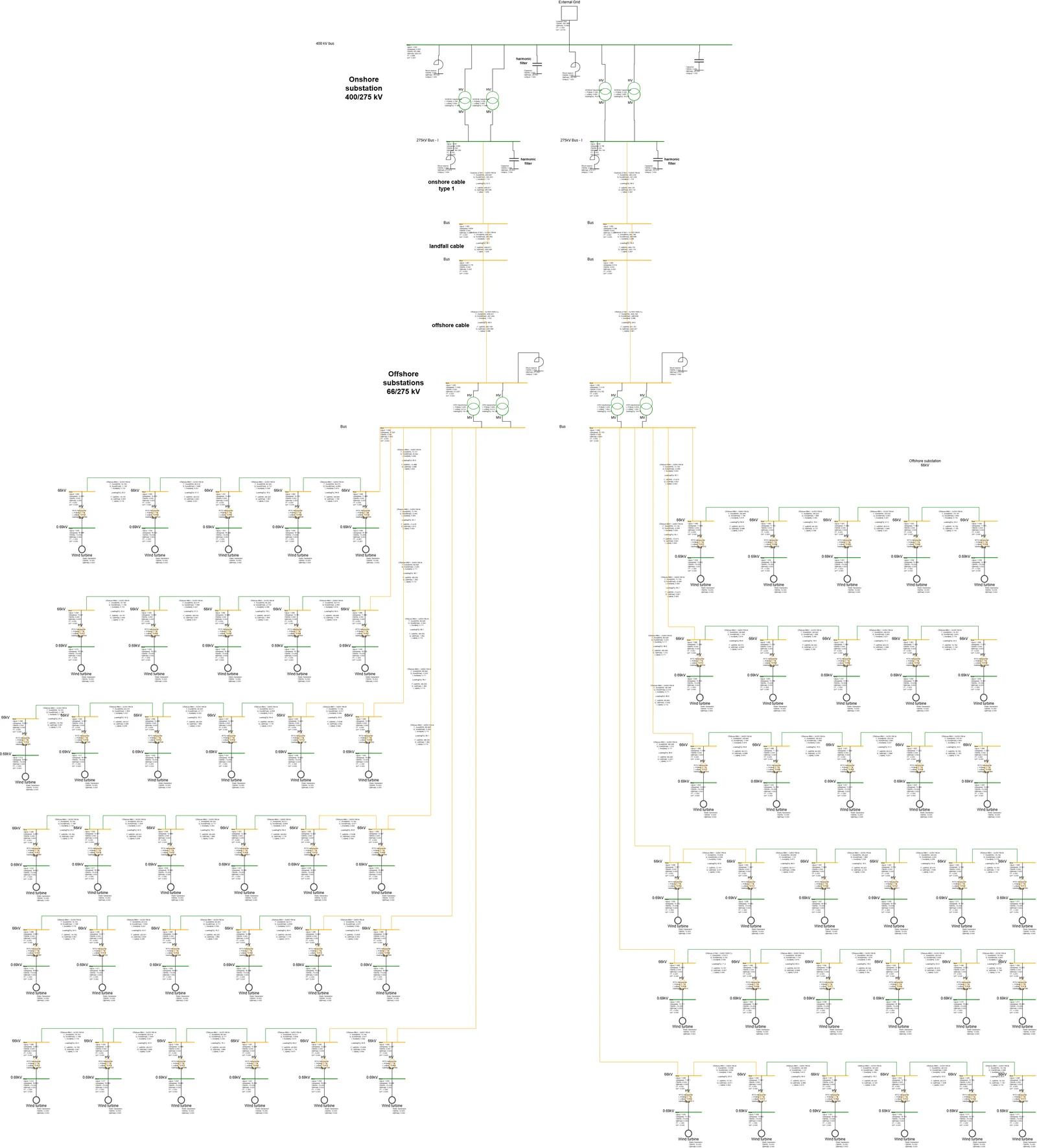
Read the full validation study →Offshore wind load flow is checked by running the same model through pandapower and OpenDSS: about 70 buses, 35 branches, and 450 MW of wind—demonstrating consistent results across two major solvers.
Read the dual-solver validation article →Electrisim's pandapower engine passes 250+ automated tests. Power flow and short-circuit results for every element are validated against DIgSILENT PowerFactory and PSS Sincal, with strict tolerances on voltage (0.000001 p.u.), angles (0.01°), and loading (0.001%)—continuous integration on every change.
Read pandapower's validation process →We are constantly testing Electrisim with other commercial software, especially Digsilent’s PowerFactory. The results match within rounding. The test cases are available as one of the templates.
Watch the comparison tutorial →Explore guides engineers search for:
ETAP alternative · PowerFactory alternative · Load flow tutorial · Short circuit analysis · Transient stability · 33 MW wind short circuit · Arc flash IEEE 1584 · Wind farm reactive power · Data center interconnection · NEPLAN alternative · Knowledge Base · Free models



~800
registered users, and growing
Electrisim is built on three widely adopted open-source power system engines. Download totals:
Get started in three simple steps
Drag and drop electrical components onto the canvas to build your power system model. Buses, lines, transformers, generators, loads, and more.
Set voltage levels, power ratings, impedances, and other parameters for each component through intuitive dialog forms.
Run load flow, short circuit, arc flash (IEEE 1584), protection coordination, optimal power flow, reactive power capability (PQ), or other analyses and view results instantly on the diagram and in tables.
Watch how easy it is to model complex electrical networks with our intuitive drag-and-drop interface
Model an electrical system, perform simulation and analyse results in a secure cloud software. You can also run the software locally — check the open-source code. Currently, the power flow, short circuit analysis, arc flash analysis (IEEE 1584-2018), motor starting / voltage dip, transient stability and eigenvalue analysis (ANDES), protection coordination study (beta), optimal power flow, contingency analysis, controller simulation, time series simulation, economic analysis, and reactive power capability (PQ diagram) are available. More to come soon.
Works in your browser or as a desktop application – you choose which is better for you.
Completely free to use when deployed locally. Built by passionate power engineers and developers, Electrisim democratizes access to professional-grade power system analysis tools for everyone. Learn more about our mission.
The calculation algorithms are based on Pandapower, OpenDSS, and ANDES, which proved to give the same results as other renowned power system analysis software. The Electrisim software is tested by numerous scenarios to verify the proper results.
The Electrisim cloud runs on Railway, a platform built for production workloads. Railway is SOC 2 Type II and SOC 3 certified, publishes security and compliance details in its Trust Center, and protects traffic with TLS. GDPR-focused processing agreements and stronger enterprise controls are available for teams that need them.
User-friendly graphical user interface (owing to Diagrams.net), based on drag-and-drop functionality for creating electrical diagrams.
Use instantly in your browser with our cloud software, or deploy locally on your computer for complete data privacy and offline capabilities.
Your subscription (from $10/month) directly funds ongoing development and new features. Subscribers help define the roadmap—tell us what you need and we prioritize it. Join a growing community of engineers shaping the future of open-source power system analysis tools.
Design networks on a geographic map: place buses, generators, transformers and loads at real locations, draw cables between them, and generate an electrical model with automatic cable length calculation. Ideal for offshore wind, distribution and transmission planning.
Real workflows: solver settings, harmonics, built-in templates, large-scale renewable models, post–load-flow Network Health Dashboard, multi-page Engineering Report PDF (cover, diagram, tables), and more—the same interface you get when you subscribe.
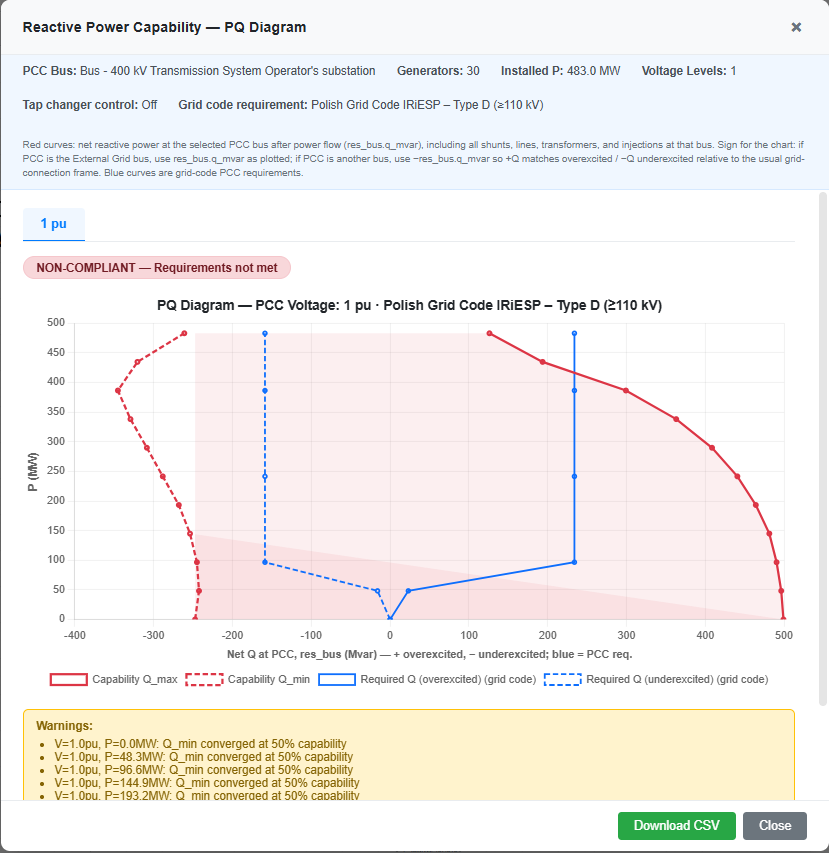
Reactive power capability (PQ diagram) — compare plant Q capability at the PCC against grid-code requirements; compliance status, voltages, and CSV export.
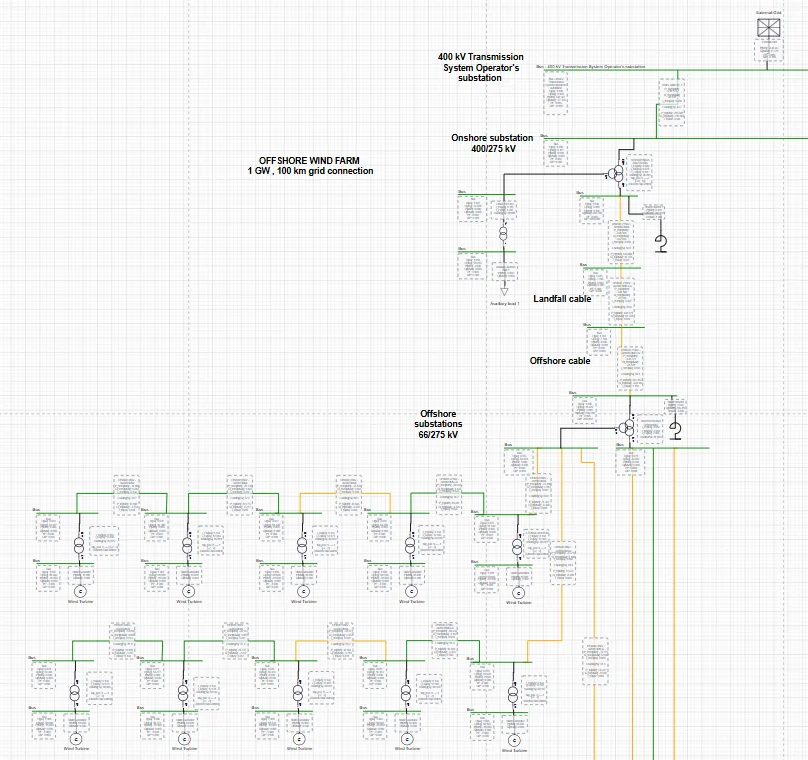
1 GW offshore wind — full single-line view from turbines to the external grid.
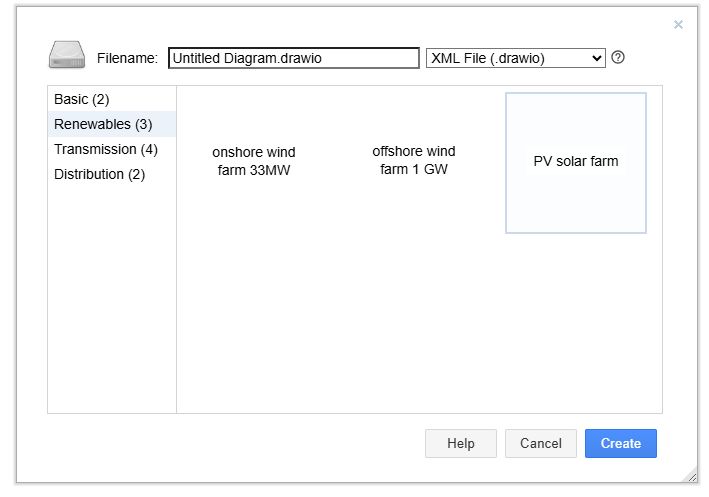
Ready-made templates — start from onshore wind, offshore, or solar examples.
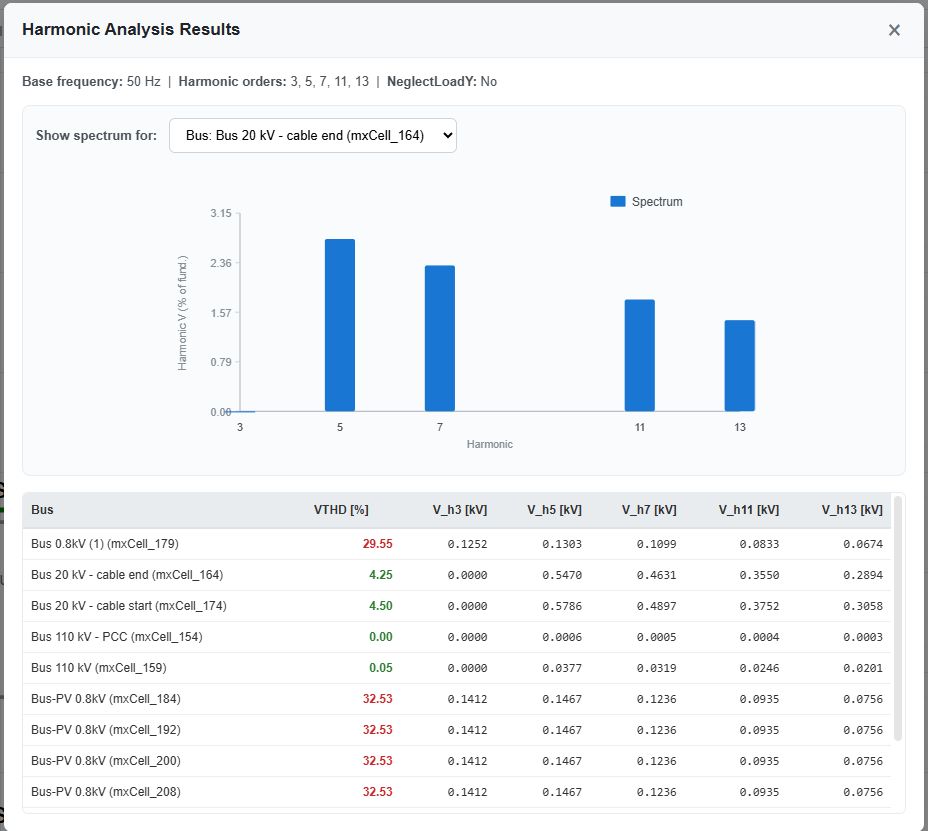
Harmonic analysis — spectrum and total harmonic distortion (VTHD) across buses.
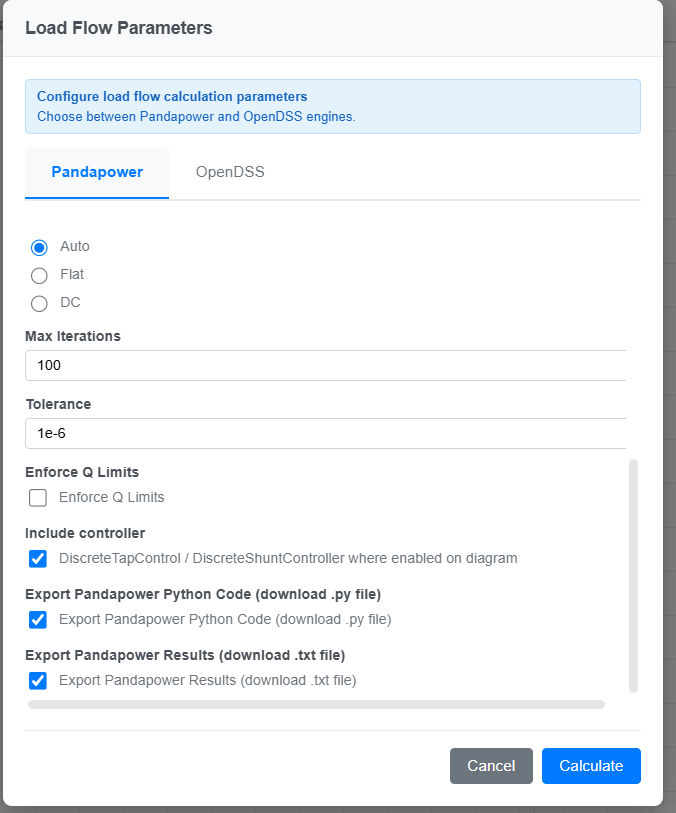
Load flow — choose Pandapower or OpenDSS, iterations, tolerances, and exports.
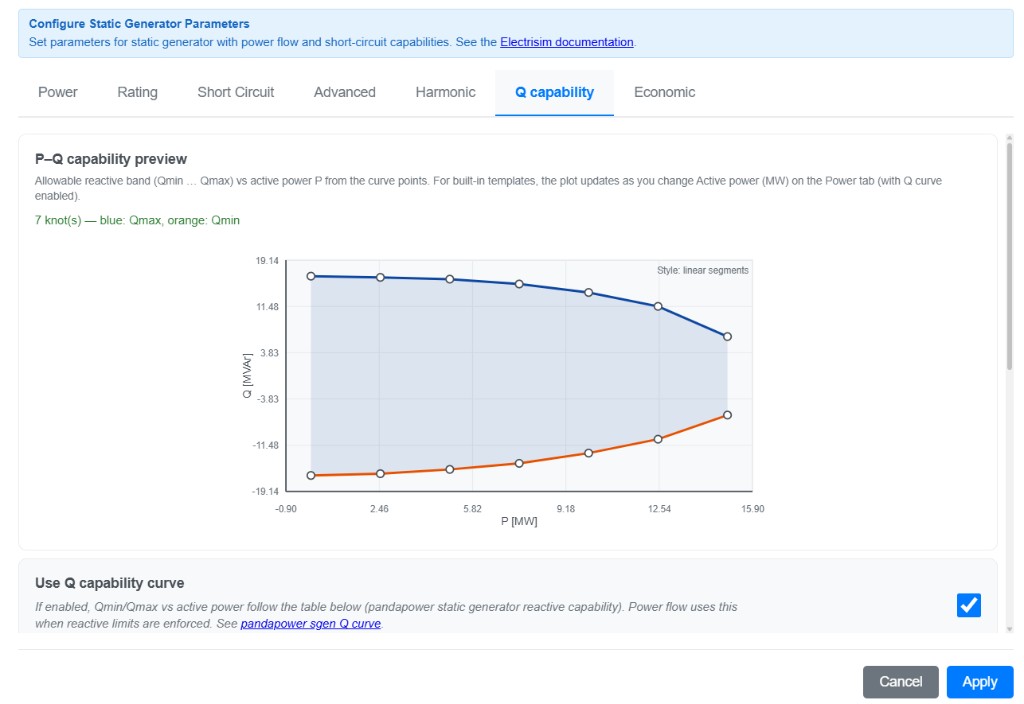
Add Reactive Power Characteristic to your generators
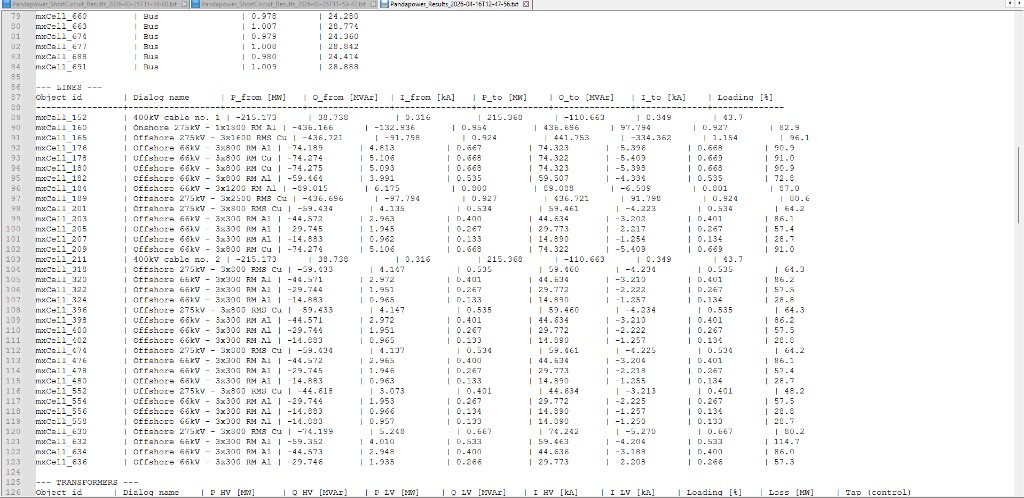
Result export — export the simulation results.
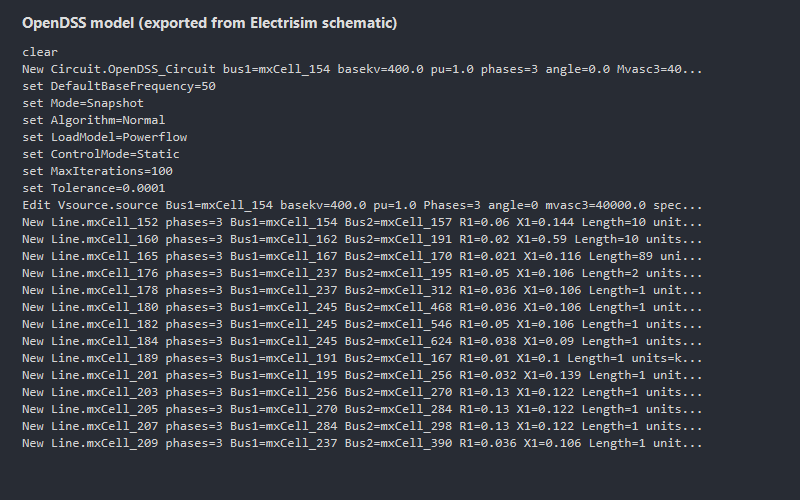
Code export — generate Pandapower or OpenDSS code based on the Electrisim schematic.
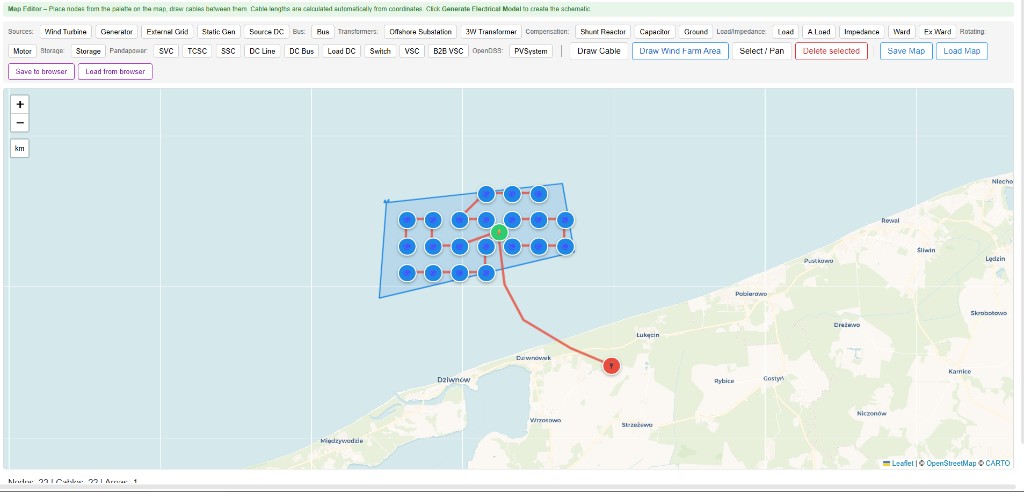
Map editor — convert automatically your model from map to electrical model.
Build any network with a comprehensive component library — available in Pandapower and OpenDSS frameworks.
…plus motors, external grids, shunts, impedances, 3-winding transformers, DC lines, switches, BESS, FACTS (SVC, TCSC, SSC), and more. See the full component library →
Electrisim is completely free and open-source. Deploy it locally for full control, or use our cloud service. Join our community of contributors and help shape the future of power system analysis.
Access via browser with premium features from $10/month (Company: $40/user/month).
Already a subscriber? Open the app →
Professional power system analysis without the enterprise price tag
| Feature | Electrisim | Commercial Software |
|---|---|---|
| Monthly Cost | $10/month (Personal) $40/user/month (Company) |
$500 or more/month |
| Load Flow Analysis | ||
| Short Circuit (IEC 60909) | ||
| Arc Flash Analysis (IEEE 1584-2018) | ||
| Motor Starting / Voltage Dip | ||
| Transient Stability (ANDES TDS) | ||
| Eigenvalue / Small-Signal (ANDES) | ||
| Protection Coordination Study (Beta) | ||
| Optimal Power Flow | ||
| Harmonic Analysis | ||
| Economic / CAPEX Analysis | Varies | |
| Reactive Power Capability (PQ at PCC) | Varies | |
| Open Source | ||
| Cloud Access (No Install) | ||
| Desktop version | ||
| Geographic Map Editor | Varies | |
| Cancel Anytime |
Cancel anytime • 30-day refund policy • Secure payment via Stripe
Support the development of open-source power system software while accessing premium cloud features
Perfect for getting started
For individual engineers — support development & unlock premium features
For teams and organizations — per-seat billing with a commercial-use license.
Academic license for students, teaching, and research.
The questions we hear most often. See all FAQs →
Subscribe in under a minute and run your first load flow today. Cancel anytime in one click.
Subscribe — from $10/monthContact us if you need assistance with our software, have any comments or suggestions for improvement, or are interested in exploring collaboration opportunities.
Copyright @2026 Electrisim. All Rights Reserved by Electrisim