Short-circuit studies on a 33 MW wind farm: IEC 60909, OpenDSS, and vector group
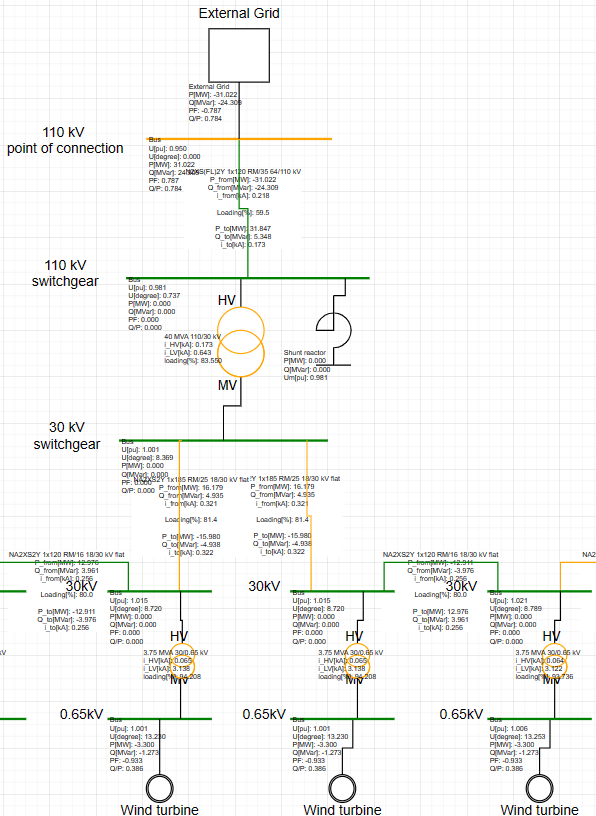
Same single-line diagram. Two fault engines. One place to read ikss, ip, and ith.
Fault levels drive breaker ratings, cable sizing, and protection settings. On renewable connections, the interesting questions are not only how many kA at the point of connection, but which fault type governs the phase conductor versus the cable screen — and whether your transformer vector group lets zero-sequence current through to the collector.
In Electrisim you run short-circuit studies in the browser on the same diagram you use for load flow. The built-in 33 MW onshore wind farm template (ten turbines, 30 kV collectors, 40 MVA 110/30 kV transformer, 110 kV export) is a practical place to compare methods without building a model from scratch.
IEC 60909 (pandapower)
Open Simulate → Short Circuit, choose the Pandapower tab, and tick IEC 60909. A three-phase maximum study on all busbars gives symmetrical current ikss, peak ip, and thermal equivalent ith for your clearing time — typically one second for conductor checks.
IEC fills buses, lines, transformers, and the external grid. That is the path you want for grid-code style studies and IEC-rated equipment.
Which current sizes what?
- Phase conductors: use three-phase ith (adiabatic / I²t, IEC 60949).
- Metallic screens and sheaths: earth-return duty — run single-phase (phase-to-earth). Two-phase-to-earth (Ik2E) is the companion case in IEC practice; the dialog’s Two phase option is phase-to-phase without earth.
- If single-phase ik exceeds three-phase on a solidly earthed bus, check the phase conductor against that earth fault too.
Vector group is not cosmetic
On the main 110/30 kV transformer, change vector group (Dyn, YNd, Yy, …) and angle shift for the clock. Three-phase ikss barely moves — positive sequence dominates. Single-phase ikss changes because grounded star, delta, and neutral paths control zero sequence. Rotating angle shift alone changes current angle, not a shortcut to lower three-phase duty.
OpenDSS FaultStudy on the same diagram
The OpenDSS tab runs a native fault study (50 Hz in Europe). Bus results use the same labels, but the method is not IEC 60909: different voltage factor, different wind-turbine contribution, fixed peak factor, and branch currents only on the IEC path. Treat OpenDSS as a useful Y-bus cross-check — not a substitute for IEC submission figures.
Try it
In the editor: File → New → onshore wind farm 33MW, then Simulate → Short Circuit.
Open the template in the browser: app.electrisim.com. Step-by-step dialog reference: Short circuit documentation.
North American projects can tick ANSI/IEEE C37 (beta) on the Pandapower tab — a separate standard from IEC 60909. See also the general short circuit analysis guide and video tutorials for related wind-farm studies.