CIGRE medium-voltage benchmark network with distributed energy resources
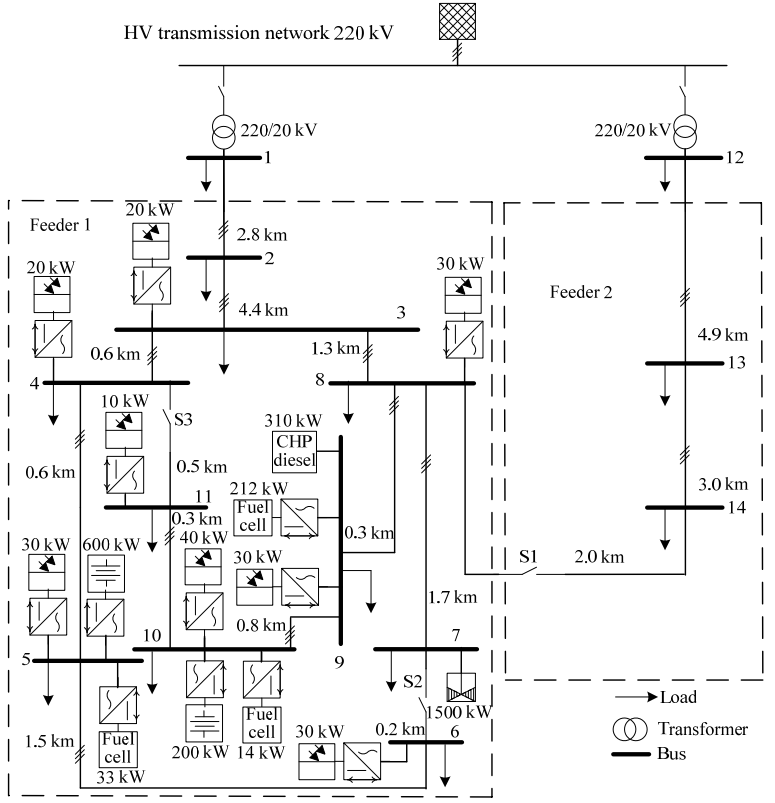
The CIGRE medium-voltage network is the reference case most papers use when they study distributed generation in a distribution network. It was published by CIGRE Task Force C6.04.02 so that methods and tools can be compared on the same data. This version includes all 15 distributed energy resources of the benchmark.
What is in the model
| Element | In the model |
|---|---|
| Voltage levels | 110 kV supply and 20 kV distribution |
| Buses | 15: one at 110 kV and 14 at 20 kV |
| Transformers | Two, 110/20 kV, each feeding one feeder |
| Lines | 15, about 25 km in total |
| Loads | 18 |
| Distributed energy resources | 15: eight photovoltaic units, one wind turbine, two batteries, two residential fuel cells, one diesel CHP unit and one fuel cell CHP unit |
The original case study gives the high-voltage side as 220 kV. Like pandapower, this model uses 110 kV, because no transformer data for 220 kV is given. Source: pandapower CIGRE MV network with all DER.
What to try with it
- Load flow with and without generation. Switch the distributed units off and on and compare the voltage profile along the feeders. With generation the voltage can rise towards the feeder end.
- Time series. Give the loads and the PV units daily profiles and see when the feeder is most loaded and when the power flows back to 110 kV.
- Voltage stability margin. Compare the buses to see where the feeder has room for a new load. See the P-V curve guide.
- Short circuit. See how much the distributed units add to the fault level. See the short circuit guide.
Download the file, then open it in the Electrisim app with File → Import from → Device. The editor can be used without an account; running a study in the cloud needs a subscription.
Related: the multi-voltage example and the IEEE test cases.