Multi-voltage example network: 380 kV down to 0.4 kV in one model
Real networks span several voltage levels, and most study questions sit at the boundaries between them: how a transmission fault looks at low voltage, where the losses are, what a tap change does two levels down. This model has five levels in one diagram, from a 380 kV grid connection to 0.4 kV feeders. It follows the multi-voltage example network of pandapower.
What is in the model
| Element | In the model |
|---|---|
| Voltage levels | 380, 110, 20, 10 and 0.4 kV |
| External grid | One, at 380 kV |
| Transformers | One three-winding transformer and two two-winding transformers |
| Lines | 26, with 163 km in total |
| Generation | One synchronous generator and 11 static generators |
| Loads | 25 |
| Other | Two extended ward equivalents and one shunt |
What to try with it
- Load flow and the Network Health Dashboard. See which level carries the highest loading and where the voltage is lowest.
- Short circuit at every level. The same network gives fault levels that differ by orders of magnitude between 380 kV and 0.4 kV. The fault current waveform example in the documentation is a 110 kV bus of this model.
- N-1 contingency. Take lines and transformers out one at a time and see which outage the lower levels feel. See the N-1 guide.
- Three-winding transformer. A good place to learn how its three sides are loaded and what the tap changer does.
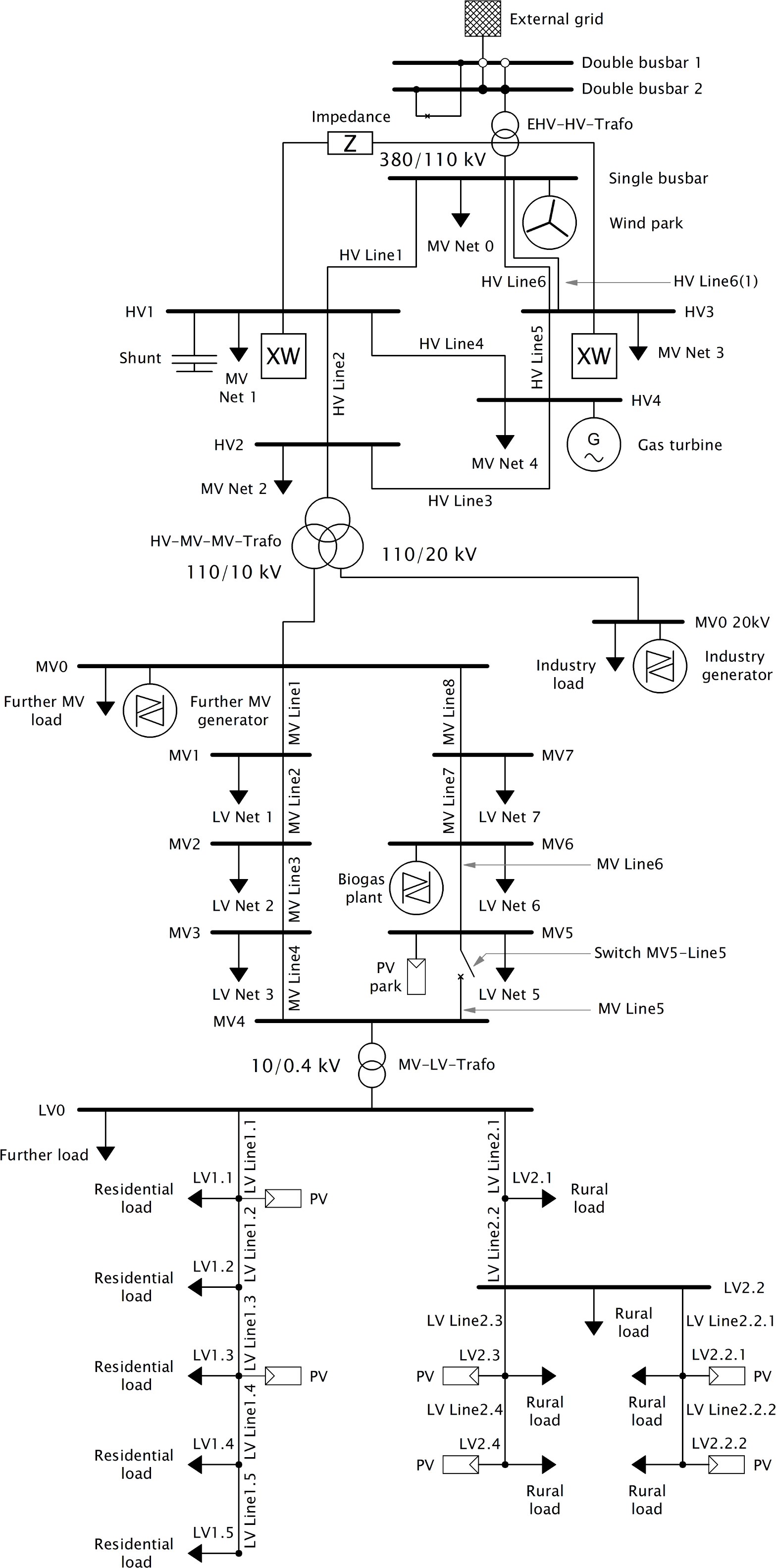
Download the file, then open it in the Electrisim app with File → Import from → Device. The editor can be used without an account; running a study in the cloud needs a subscription.
Related: the simple example if this is too much to start with, and the CIGRE medium-voltage network for a distribution benchmark.